
informational 5 min read
Code of Hammurabi: What It Is and Where to See It at the Louvre
Updated October 28, 2026
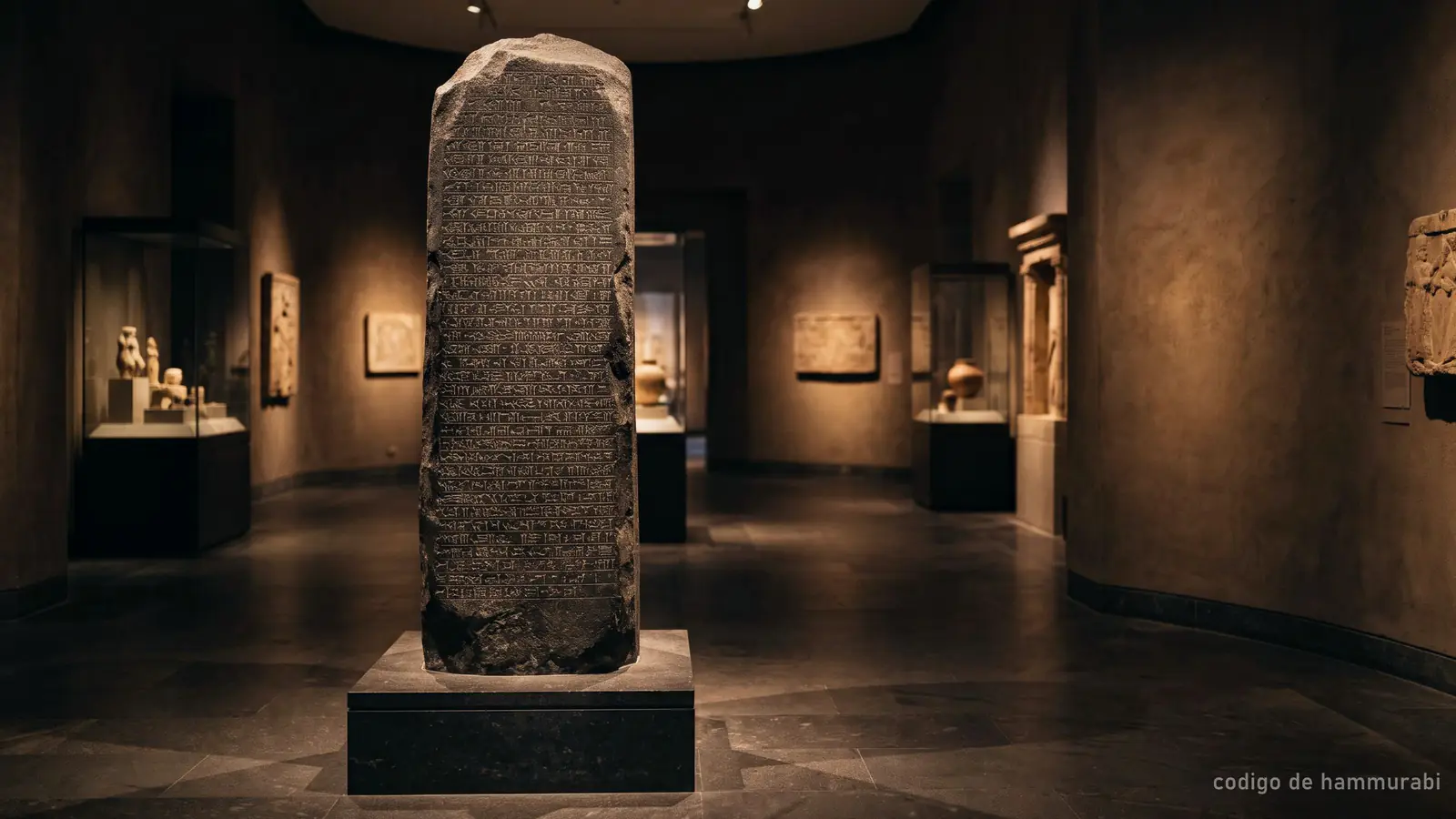
The Code of Hammurabi is a collection of laws that King Hammurabi of Babylon had carved on a black basalt stele 2.25 m high, around 1792–1750 BC. The original stele is in the Louvre Museum, in room 227 of the Richelieu wing, level 0, displayed without a case.
What is the Code of Hammurabi?
It is both an object and a text. The object is a stele, a stone slab carved to stand upright, with a relief at the top and the text engraved below. The text is a set of laws preceded by a prologue and closed by an epilogue, written in the first person to glorify the king and his gods.
In the relief, Hammurabi stands before the sun god Shamash, the main deity of the city of Larsa (some scholars suggest it is Marduk). The scene ties the king’s laws to the will of the gods, the same idea the prologue repeats.
When was it written and which civilization does it belong to?
It belongs to the Babylonian civilization of Mesopotamia, in present-day Iraq. The Louvre dates it to the First Dynasty of Babylon, during Hammurabi’s reign, around 1792–1750 BC. These are its details from the museum’s record:
| Detail | Value |
|---|---|
| Date | reign of Hammurabi, around 1792–1750 BC |
| Material | basalt |
| Size | 225 cm high, 79 cm wide, 47 cm thick |
| Find site | Susa (present-day Iran) |
| Found | 1901–1902, archaeological mission of Jacques de Morgan |
| Inventory number | SB 8 |
| Department | Near Eastern Antiquities |
What language is it written in?
It is written in Akkadian, in its Old Babylonian form, in cuneiform script: wedge-shaped signs carved into the stone. After the discovery, Father Jean-Vincent Scheil translated it into French.
What does the Code of Hammurabi say?
It says how a long list of everyday cases should be settled. The laws are numbered from 1 to 282, although some numbers are missing (66 to 99 and 110–111) because part of the text was erased. They all follow the same pattern: “if someone does such a thing, they will receive such a punishment”.
They cover a wide range of subjects:
- Criminal law: theft, injuries, false accusations.
- Family and inheritance: marriage, divorce, adoption, women’s rights.
- Trade and property: loans, rents, harvests, deposits.
- Trades: doctors’ fees, wages, builders’ liability.
Penalties depend on the social class of the victim and of the offender: the code distinguishes free men (awilum), an intermediate class (muškenum) and slaves (wardum). This is where the famous law of retaliation comes from, “an eye for an eye, a tooth for a tooth”, which appears in articles 196 (the eye), 197 (the bone) and 200 (the tooth), but only when victim and attacker are of the same rank.
What does law 229 of the Code of Hammurabi say?
Law 229 punishes the negligent builder: if a builder builds a house for a man and does not make it sound, and the house collapses and kills its owner, the builder shall be put to death. The laws that follow apply the same logic: if the owner’s son dies, the builder’s son is punished, and if property is lost, the builder must replace it.
How did the Code of Hammurabi get to the Louvre?
It came to the Louvre in the division of finds from a French excavation. The stele was carved in Mesopotamia, but around the 12th century BC the Elamite king Shutruk-Nakhunte carried it off as war booty to Susa, his capital, in present-day Iran. There the archaeological mission of Jacques de Morgan found it in the winter of 1901–1902. According to the museum’s record, it entered the collections through “division after the excavations”.
Where is the Code of Hammurabi in the Louvre?
It is in room 227 of the Richelieu wing, level 0 (ground floor), a room named after it. The stele is displayed outside a case, so you can walk around it and see the text from every side. The museum warns that the location of works can change, so confirm it on the day of your visit on the Louvre map by wing.
The Mona Lisa is in another wing, Denon, so this room means a detour if you are going to see the best-known works. If antiquity interests you, combine this room with the Louvre’s Egyptian antiquities, in the neighboring Sully wing. General admission costs €22 for European Economic Area residents and €32 for everyone else; if you would rather go in at a set time with a guided part, look at the Louvre skip-the-line ticket with reserved access.

Check prices & dates
Book your tickets in advance: popular time slots sell out.
Book tickets
From$66per person
Check availability- Free cancellation up to 24 h before on 9 of 10 options
- Louvre entry included in all of them
- Prices in US dollars
Price checked Oct 27, 2026
Sources