
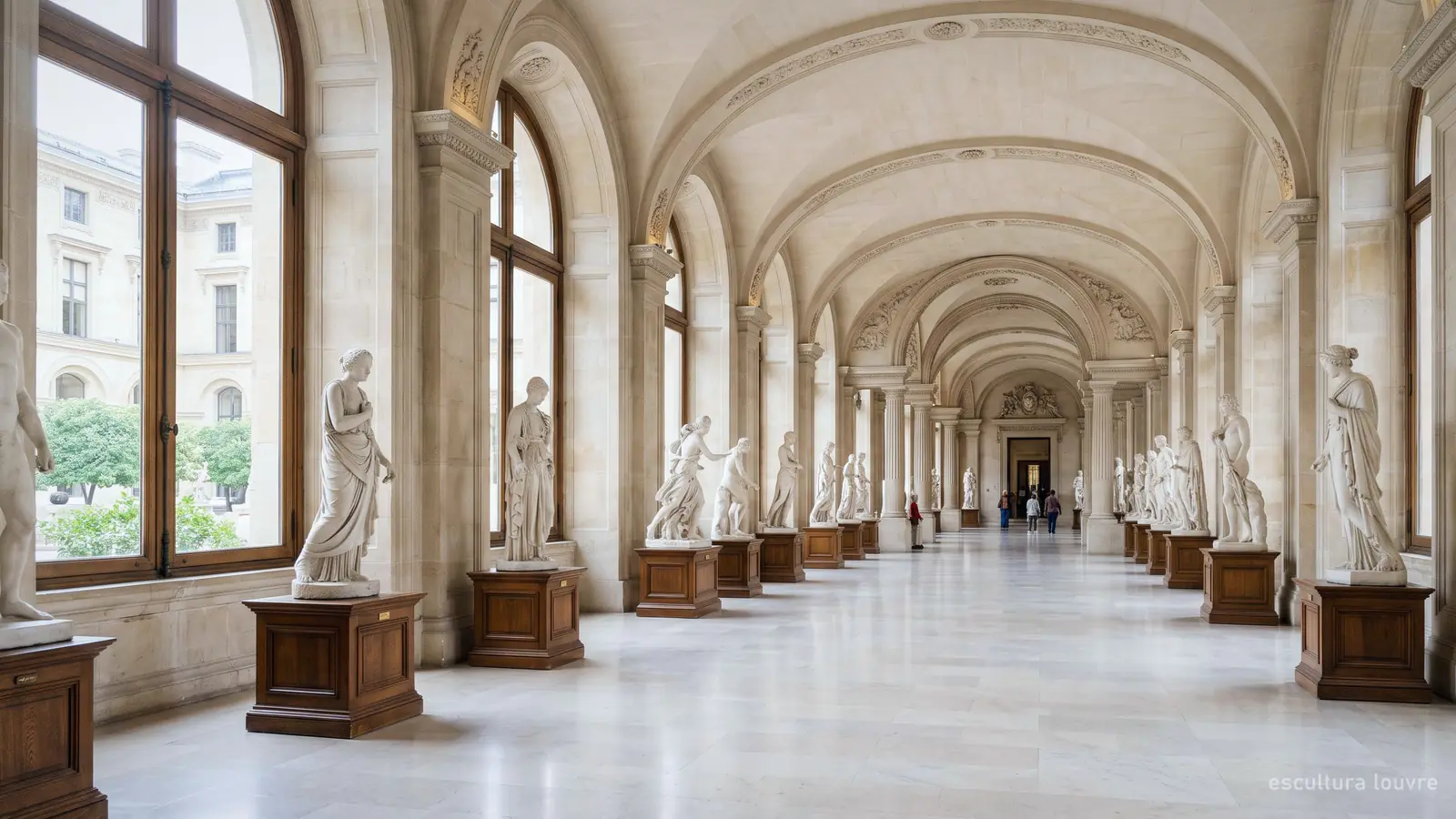
Louvre Sculptures: The Most Famous and Where to See Them
Updated October 28, 2026
The most famous Louvre sculptures are two Greek works: the Venus de Milo, in room 345 of the Sully wing, and the Winged Victory of Samothrace, at the top of the Daru staircase. Next come Michelangelo's Slaves and Canova's Psyche, together in the Michelangelo gallery (room 403, Denon wing, level 0), and the Assyrian winged bulls of the Cour Khorsabad, in the Richelieu wing. These famous sculptures in the Louvre run from Antiquity to the 18th century, with date, material, size and room according to the museum and Spanish-language Wikipedia.
- #1
Winged Victory of Samothrace
Greek antiquity. Daru staircase (room 703), Denon wing, level 1.
Parian marble, 2.75 m, 2nd century BC. It shows Nike, the goddess who announces victory, on the prow of a warship. It was found in 1863 by the French consul Charles Champoiseau in a sanctuary on Samothrace. The museum says it was first shown without its wings and drew little interest; only once the grey marble blocks were recognized as a ship was it rebuilt with its base and wings, and its fame began. It was restored again in 2014.
- #2
Venus de Milo
Greek antiquity. Room 346, Sully wing, level 0.
White marble, 2.11 m, between 130 and 100 BC, late Hellenistic period; the sculptor is unknown. A farmer found it in 1820 on the island of Milos; it was a gift to Louis XVIII and reached the Louvre in 1821. Nobody knows what its arms were doing: the museum suggests it may have held an apple or a shield in which Aphrodite admired her reflection.
- #3
Dying Slave and Rebellious Slave, Michelangelo
Italian Renaissance. Room 403 (Michelangelo gallery), Denon wing, level 0.
The Dying Slave is white marble, 2.29 m tall, carved around 1513 for the tomb of Pope Julius II, which was never finished. Michelangelo gave both figures to Roberto Strozzi in 1546; they reached France in 1550, passed through the Château d'Écouen and Cardinal Richelieu, and the State confiscated them in 1793. The museum points out a detail you miss from the front: a monkey carved behind the dying slave's legs.
- #4
Psyche Revived by Cupid's Kiss, Antonio Canova
Neoclassicism. In the same room 403, a few steps from the Slaves.
Marble, 1.55 m high and 1.68 m wide. The English colonel John Campbell commissioned it in 1787 and Canova finished it in 1793; it was later bought by Joachim Murat. Canova chose the instant Psyche comes back to life in Cupid's arms. The Louvre-Lens, in northern France, shows another version with the two lovers standing.
- #5
Sleeping Hermaphroditus
Roman copy with a mattress by Bernini. Room 348 (Caryatids), Sully wing, level 0.
A Roman marble copy of a Hellenistic original dated around 155 BC. It was dug up in Rome in 1608, near the Baths of Diocletian; Cardinal Borghese had Gian Lorenzo Bernini carve the Carrara marble mattress it lies on, around 1619–1620. Napoleon I acquired it in 1807. The museum invites you to walk around it to discover all its quirks.
- #6
The Caryatids, Jean Goujon
French Renaissance. Room 348, Sully wing, level 0: the first stop on the official trail.
Four Roman-inspired column statues holding up the musicians' gallery of the ballroom Pierre Lescot built for Henri II. In this room Marguerite de Valois married Henri of Navarre in 1572, days before the St. Bartholomew's Day massacre. Since 1692 the room has displayed ancient sculpture from the royal collections, such as Diana the Huntress.
- #7
Winged bulls of Khorsabad
Near East. Cour Khorsabad (room 229), Richelieu wing, level 0.
Human-headed winged bulls (lamassu) that guarded the gates of Sargon II's palace at Dur-Sharrukin, today's Khorsabad, between 713 and 706 BC. They were excavated in 1843 and 1844. The museum's record points out a detail: they have five legs. According to the museum, they were protective spirits that ensured the stability of the palace and the empire.
- #8
The Seated Scribe
Ancient Egypt. Department of Egyptian Antiquities, Sully wing.
Painted limestone, 53.7 cm, from the Old Kingdom (between 2480 and 2350 BC), found in 1850 in the Saqqara necropolis, opposite ancient Memphis. The eyes stand out, made of white quartz, ebony and rock crystal, more than 4,000 years after it was carved.
- #9
Marly Horses, Guillaume Coustou
18th-century France. The originals that stood on the Place de la Concorde.
Carrara marble, carved between 1743 and 1745 for the entrance to the park of the Château de Marly. In 1794 they were moved to the Place de la Concorde; in 1984 they were replaced by copies, because the July 14 parade was damaging them, and the originals have been kept in the Louvre ever since.
Frequently asked questions
What are the most famous sculptures in the Louvre?
The Winged Victory of Samothrace (Daru staircase) and the Venus de Milo (room 345), followed by Michelangelo's Slaves and Canova's Psyche (room 403), Jean Goujon's Caryatids and the Sleeping Hermaphroditus (room 348), the winged bulls of Khorsabad (room 229) and the Seated Scribe.
What does the Dying Slave represent?
A captive bound with thin cords who seems asleep, perhaps forever, beside the Rebellious Slave, who struggles to break free. Michelangelo carved them for the tomb of Julius II and left them unfinished. The museum offers two readings: men unable to rise to the world of ideas, or the Arts grieving the pope's death; depending on which you choose, the monkey carved behind stands for material life or for Painting.
What is an Assyrian winged bull?
A lamassu: a protective spirit with a bull's body, wings and a human head that flanked the gates of Assyrian palaces. The Louvre's come from Sargon II's palace at Khorsabad (713–706 BC) and stand in the Cour Khorsabad, room 229 of the Richelieu wing.
Where are the Venus de Milo and the Winged Victory of Samothrace?
The Venus de Milo is in room 345 of the Sully wing, level 0. The Winged Victory of Samothrace is at the top of the Daru staircase (room 703), Denon wing, level 1. The museum's official trail links them in a few minutes: from the Venus you head back toward the Salle de Diane, climb the staircase and the Victory appears above you.
What is the Sleeping Hermaphroditus?
A Roman marble copy of a Greek original from around 155 BC that Napoleon I acquired in 1807. The mattress it sleeps on was carved by Bernini in Rome around 1619–1620. It is in the Salle des Caryatides (348), where the museum invites you to walk around it to see it whole.
Sources