
What to See at the Louvre in 2 or 3 Hours: The Must-Sees
Updated October 28, 2026
What to see at the Louvre, in short: the Mona Lisa and The Wedding Feast at Cana in room 711, the Venus de Milo in 345, the Winged Victory of Samothrace at the top of the Daru staircase, The Raft of the Medusa and Liberty Leading the People in room 700, and Michelangelo's Slaves with Canova's Psyche in 403. The museum itself links almost all of these Louvre highlights in its Masterpieces trail, which it times at 1 hour 30 minutes. With 2 hours you do that trail without rushing; with 3 you add the Richelieu wing: the winged bulls of Khorsabad, the Code of Hammurabi and Napoleon III's apartments. The list follows the order of the official trail, so you can read it as a route.
- #1
Jean Goujon's Caryatids
The first stop on the official trail, in room 348 of the Sully wing, level 0.
The museum starts its masterpieces route here. The Salle des Caryatides was the ballroom of Henri II's Renaissance palace: the architect Pierre Lescot had Jean Goujon make a musicians' gallery held up by four column statues. In 1572 it hosted the wedding of Marguerite de Valois and Henri of Navarre, days before the St. Bartholomew's Day massacre. Since 1692 it has displayed ancient sculpture; here is the Sleeping Hermaphroditus, acquired by Napoleon I in 1807.
- #2
Venus de Milo
Room 346, Sully wing, level 0, just after the Caryatids.
White marble, 2.11 m, carved between 130 and 100 BC by an unknown sculptor. A farmer found it in 1820 on the Greek island of Milos (Melos); it was a gift to Louis XVIII, who gave it to the museum, and it reached the Louvre in 1821. According to the museum, it arrived at an emptied Louvre: in 1815 the Congress of Vienna had forced the return of some 5,000 works looted by Napoleon. It was found without arms and people still debate whether it held an apple or a shield.
- #3
Winged Victory of Samothrace
At the top of the Daru staircase (room 703), Denon wing, level 1.
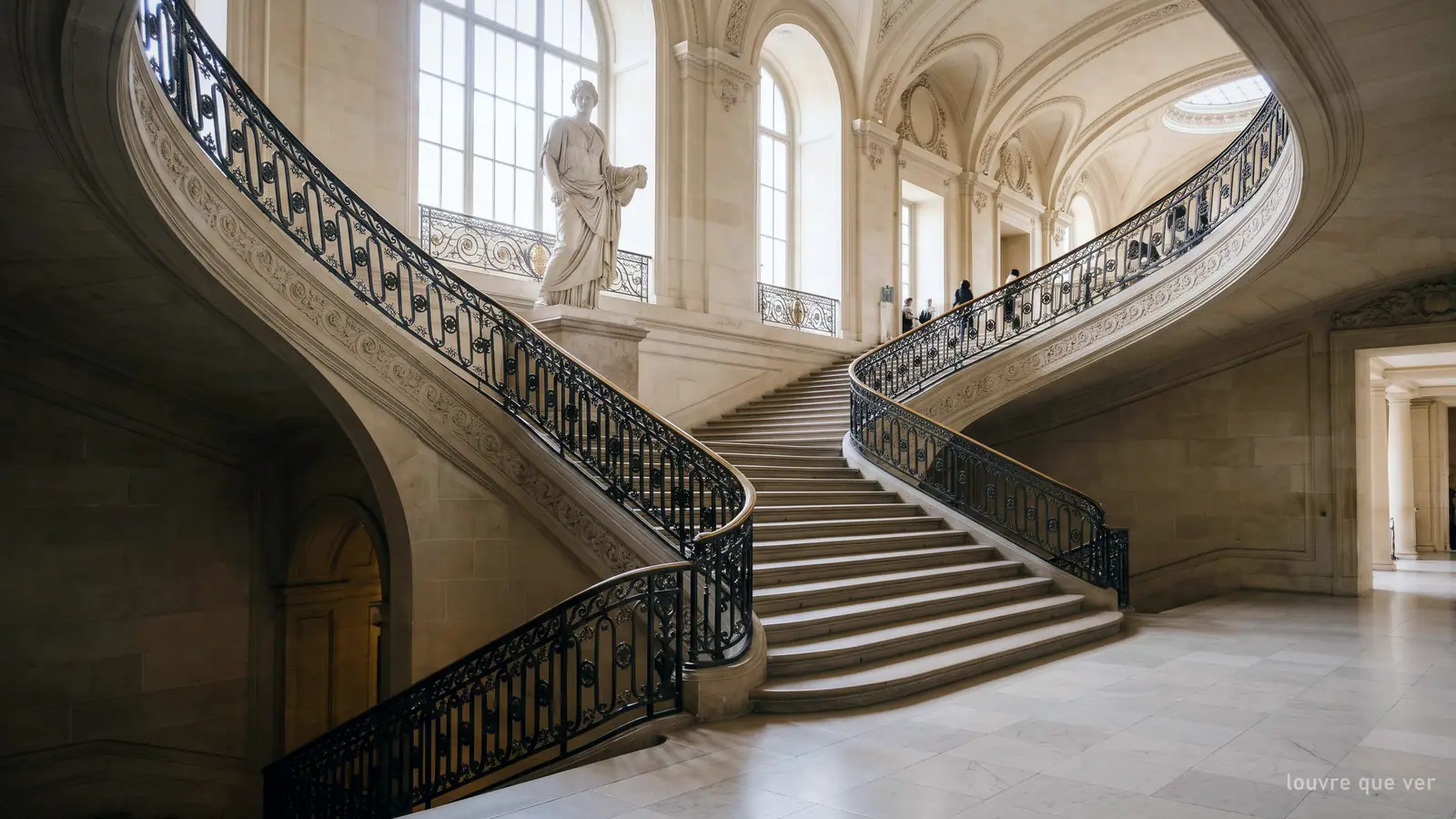
A 2.75 m Parian marble statue from the 2nd century BC showing Nike, the goddess of victory, alighting on the prow of a warship. The French consul Charles Champoiseau found it in 1863 in a sanctuary on the island of Samothrace. The museum explains that it was first shown without wings or ship; once the grey marble blocks of the prow were identified, it was rebuilt with its base and wings. It came out of its last restoration in 2014, after a year and a half of cleaning.
- #4
Leonardo in the Grande Galerie
Room 710, Denon wing, level 1: La Belle Ferronnière and Saint Anne, before the Mona Lisa.
The Louvre holds five paintings and twenty-two drawings by Leonardo da Vinci. In the Grande Galerie, on the way to the Mona Lisa, two of them hang: the Portrait of a Woman, known as La Belle Ferronnière (possibly Lucrezia Crivelli, mistress of Ludovico Sforza; the nickname comes from a mistake by Ingres) and The Virgin and Child with Saint Anne, the Child playing with a lamb. Just before, in room 708, the Salon Carré is where the Royal Academy of Painting and Sculpture's "Salon" was born.
- #5
Mona Lisa (La Gioconda)
Room 711, the Salle des États: the museum's largest room, Denon wing, level 1.
Oil on poplar panel, 79 × 53 cm, which Leonardo began around 1503 and probably kept retouching until 1519. It portrays Lisa Gherardini. It has been in the Salle des États since 1966, behind a case that controls temperature and humidity. It was stolen on August 21, 1911 and recovered more than two years later. There is a line to see it head-on; the museum suggests using the wait to look at The Wedding Feast at Cana, on the opposite wall.
- #6
Veronese's The Wedding Feast at Cana
In the same room 711, opposite the Mona Lisa: the largest painting in the Louvre.
Almost 70 m² of canvas painted by Paolo Veronese in 1562–1563 for the refectory of the monastery of San Giorgio Maggiore in Venice. Veronese painted the biblical miracle as a Venetian party of his own time. Napoleon's troops took it in 1797 and it had to be rolled up to move it to Paris; it has been in the Louvre since 1798.
- #7
Géricault's The Raft of the Medusa
Room 700 (Salle Mollien), next to the Salle des États, Denon wing, level 1.
Oil on canvas, 4.91 × 7.16 m, painted in 1818–1819 and shown at the Salon of 1819. It tells a true story: the wreck of the frigate Méduse in July 1816. According to the museum, of the 150 castaways left adrift on a makeshift raft for thirteen days, only 15 were rescued alive. Géricault worked on it for eight months, and it entered the Louvre in 1824, shortly after the painter's death.
- #8
Delacroix's Liberty Leading the People
Also in room 700, a few meters from The Raft of the Medusa.
Oil on canvas, 2.60 × 3.25 m, painted in 1830. It does not show the Revolution of 1789, as many people think, but the July 1830 revolution against Charles X: three days of barricades in Paris. The French State bought it in 1831, but it was not shown at the Louvre until 1863. According to the museum, it is Delacroix's best-known work. As you leave the room there is the Café Mollien, with restrooms, if you need a break.
- #9
David's The Coronation of Napoleon
The coronation of December 2, 1804 in Notre-Dame, on a canvas more than six meters high.
Jacques-Louis David began painting it on December 21, 1804 and gave it the final touch in November 1807. It shows the ceremony in Notre-Dame cathedral. It is an oil on canvas more than 6 m high and almost 10 m wide. The original is in the Louvre; David himself later painted a replica, which is in the Palace of Versailles.
- #10
Michelangelo's Slaves and Canova's Psyche
Room 403, the Michelangelo gallery, Denon wing, level 0: two masterpieces in one room.
The Dying Slave (marble, 2.29 m, around 1513) and the Rebellious Slave were meant for the tomb of Pope Julius II, which was never finished; they have been in France since 1550 and in the Louvre since 1793. In the same gallery is Antonio Canova's Psyche Revived by Cupid's Kiss: commissioned in 1787, finished in 1793, marble 1.55 m high. From the landing at the exit you can see the Pyramid, the last stop on the official trail.
- #11
The winged bulls of Khorsabad and the Code of Hammurabi
Richelieu wing, level 0: the Cour Khorsabad (room 229) and room 227.
For the 3-hour route. The human-headed winged bulls (lamassu) guarded the gates of Sargon II's palace at Dur-Sharrukin, today's Khorsabad (Iraq), between 713 and 706 BC; they were excavated in 1843 and 1844. Close by, in room 227, is the stele of the Code of Hammurabi: 2.25 m of black stone carrying the laws of the king of Babylon, around 1750 BC, found at Susa (Iran) in December 1901 by Jacques de Morgan's expedition.
- #12
The Seated Scribe and Napoleon III's apartments
Two more stops if you have three hours: Egypt in the Sully wing and the Second Empire in Richelieu.
The Seated Scribe is a 53.7 cm painted limestone statue from Egypt's Old Kingdom (between 2480 and 2350 BC), found in 1850 in the Saqqara necropolis; its eyes are white quartz and rock crystal. Napoleon III's apartments (rooms 544 to 535, Richelieu wing, level 1) are, according to the museum, the only Second Empire reception rooms preserved and open to the public; next to them is the Café Richelieu.
Frequently asked questions
How long should you spend at the Louvre?
For the most famous works, between 1 h 30 and 3 hours. The museum's official Masterpieces trail takes 1 h 30 and has eleven stops; most of the guided tours we review last 2 to 2.5 hours. Seeing all of it in a day is not realistic: the museum opens for 9 hours (9:00 am–6:00 pm), with last admission 1 hour before closing and galleries clearing 30 minutes before. On Wednesdays and Fridays it closes at 9:00 pm.
What should you see at the Louvre in 2 hours?
Follow the order of the official trail: the Caryatids (room 348) and the Venus de Milo (345) in the Sully wing; the Winged Victory of Samothrace (703), the Grande Galerie with Leonardo (710), the Mona Lisa and The Wedding Feast at Cana (711), The Raft of the Medusa and Liberty Leading the People (700) in the Denon wing, level 1; and to finish, Michelangelo's Slaves and Canova's Psyche in room 403. The museum allows 1 h 30; with 2 hours you cover the lines and the Mona Lisa room.
What should you see at the Louvre in 3 hours?
The 2-hour route plus the Richelieu wing: the winged bulls of the Cour Khorsabad (room 229) and the Code of Hammurabi (room 227), on level 0, and Napoleon III's apartments (rooms 544 to 535), on level 1, where you can stop at the Café Richelieu. If you have time left, the Seated Scribe is in the Egyptian antiquities of the Sully wing.
How is the Louvre laid out?
In three wings that branch off the hall under the Pyramid: Denon (large-format Italian and French painting, the Mona Lisa, the Winged Victory of Samothrace, Italian sculpture), Sully (the old palace, the Venus de Milo, Greek and Egyptian antiquities) and Richelieu (the Near East, decorative arts, Napoleon III's apartments). Each wing has several levels; the rooms are numbered and the museum publishes a map.
What should you see at the Louvre with kids?
Big works with a story work better than rooms of small paintings: the Winged Victory at the top of the stairs, the five-legged winged bulls, the Seated Scribe with its crystal eyes, The Raft of the Medusa and the Mona Lisa. Under-18s get in free, but it is worth booking their time slot too. Afterward, the Tuileries Garden has toy sailboats, a carousel and a playground.
Guided tour or on your own?
On your own, the official ticket (22 € for EEA residents, 32 € for everyone else) and the museum's published 1 h 30 trail are enough. A guided tour adds someone who leads you room by room and explains the works; most of the ones we review last 2 to 2.5 hours and include a timed ticket. Bear in mind that no ticket skips the security check.
What is there to see near the Louvre Museum?
Leaving by the Pyramid, you have the Arc de Triomphe du Carrousel (1806–1808) in front of you and the Tuileries Garden behind it, free, with the Musée de l'Orangerie and Monet's Water Lilies at its western end. Crossing the Seine on the Léopold-Sédar-Senghor footbridge brings you to the Musée d'Orsay.
Sources