
Tuileries Garden: Hours, Arc du Carrousel and What to See
Updated October 28, 2026
The Tuileries Garden (Jardin des Tuileries) is the Louvre's garden: it starts at the foot of the Arc du Carrousel, facing the Pyramid, and runs to the place de la Concorde. It is free and opens 7:00 am to 9:00 pm in spring and fall, 7:00 am to 11:00 pm in summer and 7:30 am to 7:30 pm in winter. It covers 25.5 hectares, was created by Catherine de' Medici from 1564, redesigned by André Le Nôtre from 1664 and is the oldest French formal garden in Paris. At its western end is the Musée de l'Orangerie, with Monet's Water Lilies.
What it is and how to walk it
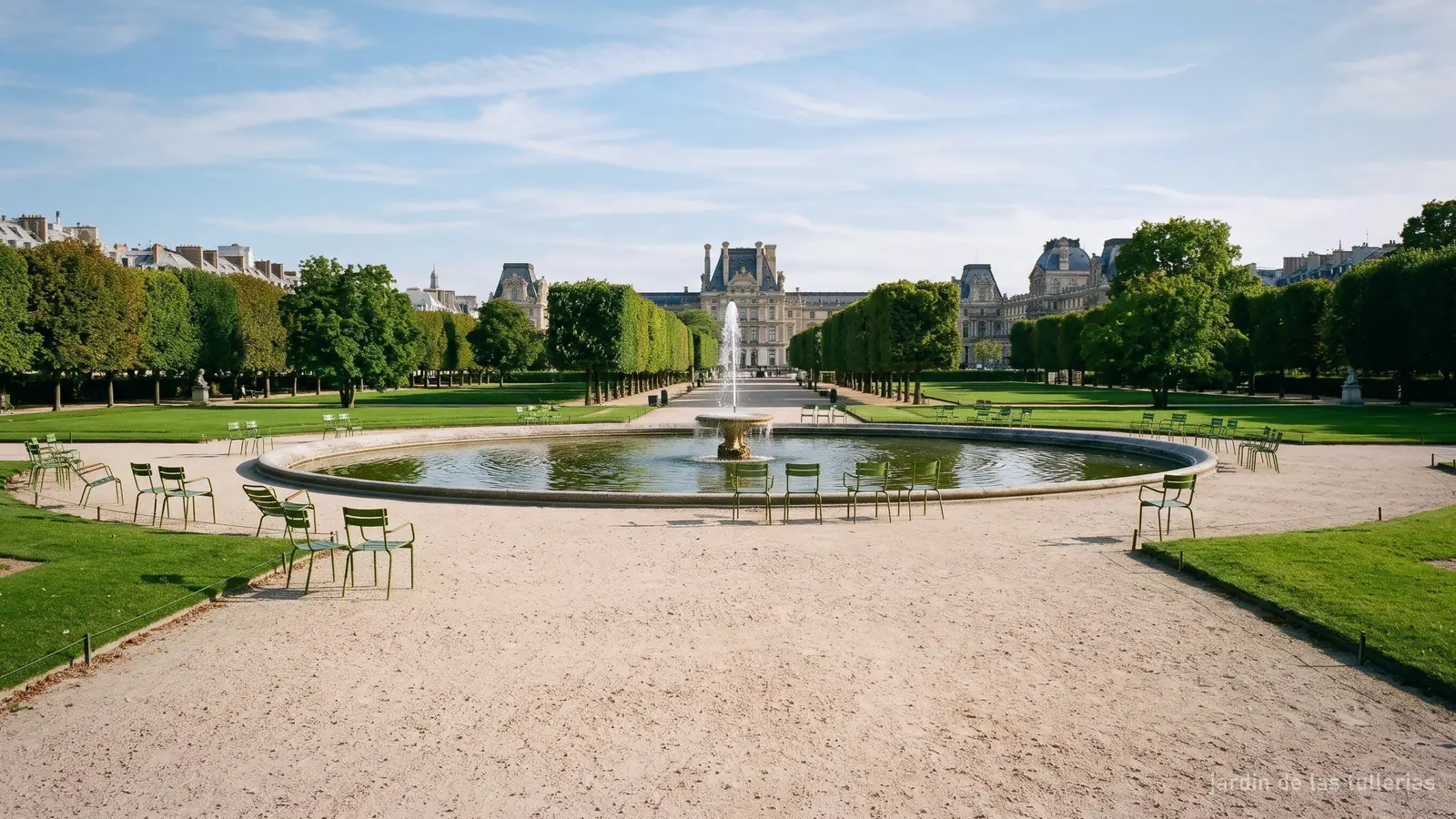
The garden fills the space between the Louvre palace, rue de Rivoli, the place de la Concorde and the Seine. Its spine is the Grande Allée, the central walk Le Nôtre laid out: about 350 meters between a round pond to the east and the great octagonal pond, 60 meters across, to the west. Along the sides run two raised terraces, the Terrasse des Feuillants by rue de Rivoli and the Terrasse du Bord de l'Eau by the Seine, designed for looking down on the garden. From end to end, from the Arc du Carrousel to Concorde, it is almost 1 km in a straight line. The garden has been a historic monument since 1914 and since 1991 has been part of the banks of the Seine World Heritage Site listed by UNESCO. According to the Louvre, its more than 3,000 trees shelter more than thirty bird species, 21 of them strictly protected in France.
What the Tuileries were
The name comes from the tile works (tuiles, in French) that stood on the land in the Middle Ages. In 1564 Catherine de' Medici began building the Tuileries Palace there, next to the Louvre, with an Italian garden of 500 by 300 meters. In 1664 Louis XIV had Le Nôtre redesign it entirely; the garden opened to the public in 1667 and became a public park after the Revolution. The palace no longer exists. During the Paris Commune, in 1871, the Communards set it on fire and tried to burn the Louvre too; the ruins were demolished in 1883. That is why today, from the Louvre courtyard, you can see straight through the garden to Concorde.
The Arc du Carrousel
The Arc de Triomphe du Carrousel stands between the Pyramid and the garden. Charles Percier and Pierre-François-Léonard Fontaine built it between 1806 and 1808 to celebrate Napoleon's victories, modeling it on the Arch of Constantine in Rome. The bas-reliefs tell the story of the 1805 campaigns, and the columns are pink marble topped by soldiers of the Grande Armée. On top it carried the four bronze horses taken in 1797 from St. Mark's Basilica in Venice; in 1815 they were returned to Venice and in 1828 the current quadriga, a copy, was put in place. Napoleon did not want to see his own statue on the arch: the one cast to crown it is kept in the Louvre today.
Hours and entry
Entry is free. The hours change by season: 7:00 am–9:00 pm in April, May, September and October; 7:00 am–11:00 pm in June, July and August; 7:30 am–7:30 pm from November to March. The garden starts clearing 30 minutes before closing. There are two free restrooms during opening hours, one by the place de la Concorde entrance and one by the rue de Rivoli entrance, opposite rue du 29 Juillet; in summer four more are added, with an accessible cabin. The garden does not close on Tuesdays, the day the Louvre is closed.
The Orangerie and the Jeu de Paume
At the Concorde corner stand two twin Second Empire pavilions: the Orangerie, from 1852, to the southwest, built to shelter the garden's orange trees, and the Jeu de Paume, from 1861, to the northwest, now the Galerie nationale du Jeu de Paume, devoted to contemporary art. The Orangerie passed to the national museums in 1921 and holds Claude Monet's Water Lilies; it opens 9:00 am to 6:00 pm, closes on Tuesdays and admission costs 12.50 € online or 11 € at the door.
With kids
Most activities are in the northern part, by rue de Rivoli. On the great octagonal pond you can rent toy sailboats that you push off with a stick, a garden tradition since 1850 (6 €). Near the Castiglione entrance there is a free playground, with a slide and a rope walkway among the trees, and a carousel inspired by Charles Perrault's fairy tales (3 €). Between the Terrasse des Feuillants and the octagonal pond there are trampolines for children over two (3 €).
Pairing it with the Louvre
The natural way is to leave the museum by the Pyramid, pass under the Arc du Carrousel and cross the garden westward to the Orangerie and Concorde. For food, the Louvre lists five spots in the garden: the Eric Kayser bakery by the Arc du Carrousel, Petit Plisson by the bandstand (9:00 am–9:00 pm), the Terrasse de Pomone beside a pond (10:00 am–6:00 pm), the Petit Farmers ice-cream kiosk by the octagonal pond and the Café des Marronniers, closed for works until summer 2027. By metro, the garden has Tuileries station (line 1) on rue de Rivoli and Concorde (lines 1, 8 and 12) at its western end.
The gardens, on the Louvre websiteTuileries Garden opening hoursMusée de l'Orangerie
Frequently asked questions
Is the Tuileries Garden free?
Yes, entry is free all year. You only pay for some children's activities (toy sailboats 6 €, carousel and trampolines 3 €) and the museums inside it, such as the Orangerie.
What are the Tuileries Garden opening hours?
7:00 am to 9:00 pm in April, May, September and October; 7:00 am to 11:00 pm in June, July and August; and 7:30 am to 7:30 pm from November to March. The garden starts clearing 30 minutes before closing.
Where is the Tuileries Garden and how do you get there?
In the 1st arrondissement of Paris, between the Louvre and the place de la Concorde, with rue de Rivoli to the north and the Seine to the south. Metro Tuileries (line 1) or Concorde (lines 1, 8 and 12); from the Louvre, just walk through the Arc du Carrousel.
What were the Tuileries, and does the palace still exist?
The Tuileries was a royal palace that Catherine de' Medici began in 1564 next to the Louvre, on land once occupied by tile works (tuiles). The Communards burned it in 1871 and the ruins were demolished in 1883; today only the garden remains.
What is there to do in the Tuileries Garden?
Stroll the Grande Allée from the Arc du Carrousel to Concorde, see Monet's Water Lilies at the Orangerie, rent a toy boat on the octagonal pond, climb to the Terrasse du Bord de l'Eau for a view of the Seine and stop at one of its cafés or kiosks.
Sources