
informational 6 min read
Louvre Pyramid: Who Built It, How Big It Is, the Inverted One
Updated October 28, 2026
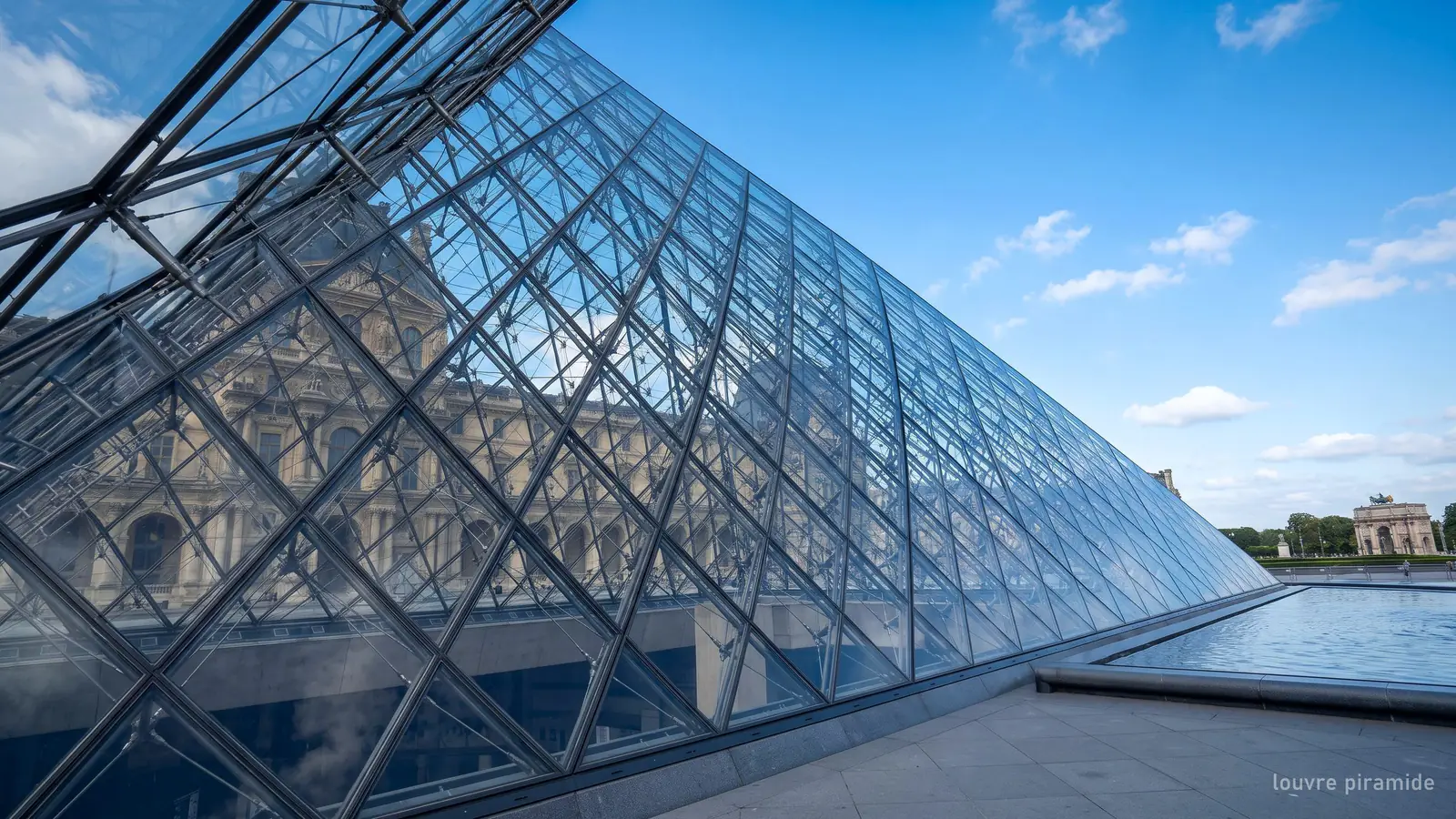
The Louvre Pyramid was designed by the Chinese-American architect I. M. Pei (Ieoh Ming Pei) on a commission from President François Mitterrand. It was built between 1985 and 1989 and opened to the public on March 29, 1989. It is a glass and metal pyramid 21.64 m tall in the middle of the Cour Napoléon, and beneath it lies the museum’s main entrance. Three small pyramids surround it, and a fifth, inverted one sits under the Carrousel du Louvre.
Who built the Louvre Pyramid and when?
It was designed by I. M. Pei (1917–2019). Mitterrand chose him without an architectural competition, and Pei accepted the commission in June 1983, according to Spanish Wikipedia. The key dates:
| Date | What happened |
|---|---|
| September 24, 1981 | Mitterrand announces that the museum will take over the whole palace, then shared with the Ministry of Finance |
| June 1983 | Pei accepts the “Grand Louvre” project |
| 1984 | The pyramid becomes part of the final project and is made public |
| 1985–1989 | Construction |
| March 4, 1988 | First inauguration, by Mitterrand |
| March 29, 1989 | Opening to the public |
Why does the Louvre have a pyramid?
Because the museum needed a central entrance. Until then visitors came in through the Denon wing door, which was not enough for a museum of that size, according to Spanish Wikipedia. Pei proposed using the Cour Napoléon as a large entrance hall, underground and full of light, from which visitors reach all three wings. The pyramid is the roof of that hall: it lets the light in and, by its shape, contrasts with the palace buildings.
The idea of a pyramid in the courtyard was not new. Spanish Wikipedia records 19th-century proposals, including an 1809 pamphlet calling for a pyramid in honor of Napoleon.
Why was it so controversial?
Because it broke with the classical palace. The day after the project was presented in 1984, the newspaper France Soir ran the headline “The new Louvre already causes a scandal”. Critics compared it to “a house of the dead”, a “funnel” or something out of an amusement park, and Mitterrand was nicknamed “Mitteramsès”, according to Spanish Wikipedia.
The battle ended in 1986. Jacques Chirac, then mayor of Paris, was won over after seeing a full-size simulation made of cables, set up in the courtyard on May 1, 1985.
A legend that still circulates says the pyramid has 666 panes. It is false: it has 673, as you can count face by face, according to Spanish Wikipedia. The 1984 controversy flared up again in 2003 with Dan Brown’s novel The Da Vinci Code.
How big is the Louvre Pyramid?
| Fact | Figure (Spanish Wikipedia) |
|---|---|
| Height | 21.64 m |
| Base side | 35.42 m |
| Base area | 1,254 m² |
| Structure | 95 t of steel and 105 t of aluminum |
| Panes | 603 rhombuses and 70 triangles (673 in total) |
| Glass thickness | 21 mm, laminated |
Pei demanded glass that was as clear as possible, something that had not yet been achieved at that scale. The glassmaker that won the contract solved it with laminated glass made in an electric furnace, according to Spanish Wikipedia.
How many pyramids does the Louvre have and what is the Inverted Pyramid?
It has five: the large one, three small ones around it that act as skylights, and a fifth inverted one, pointing downward. The Inverted Pyramid is under the Place du Carrousel, above the Carrousel du Louvre shopping center. It was built on the same principle as the large one, with 84 rhombuses and 28 triangles, and outside it is covered by almost flat glass, hidden among hedges, so that water does not collect on it (Spanish Wikipedia).
How do you enter the museum through the Pyramid?
The Pyramid is the entrance for everyone, according to the Louvre’s official page (checked October 27, 2026). There are three lines:
- Green, priority, if you already have a ticket or a Paris Museum Pass.
- Orange, if you arrive without a ticket.
- Blue, priority, for visitors with disabilities.
Under the pyramid there is a cylindrical elevator for people with reduced mobility, non-motorized wheelchairs and strollers. The other entrance open to everyone is the Carrousel entrance, at 99 rue de Rivoli, through the shopping center. The closest metro to that door is Palais-Royal / Musée du Louvre (lines 1 and 7).
The hall became too small. It was designed for three to five million visitors a year, and twenty years later it was receiving nine and a half million, so between 2014 and 2016 the museum reorganized the entrances and the Hall Napoléon (Spanish Wikipedia).
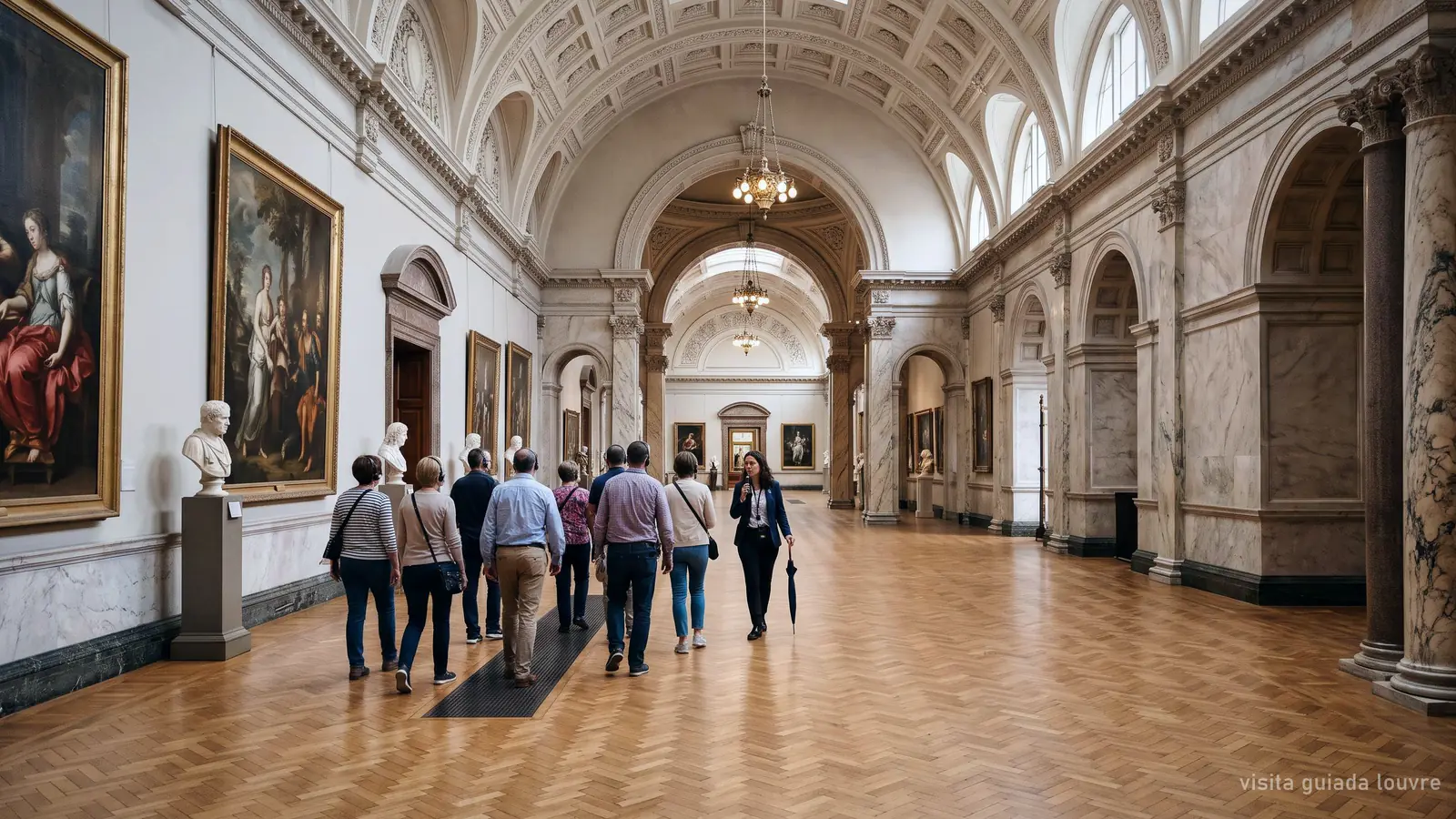
To get there without wasting time, see how to get to the Louvre and which entrance to use. General admission costs 22 € for residents of the European Economic Area and 32 € for everyone else, always with a time slot. If you want to arrive with your ticket already bought and a guided part up to the Mona Lisa, the Louvre skip-the-line ticket with reserved access gives you both in one booking. The pyramid is the final chapter of a long story; read the rest in the Louvre history.
Check prices & dates
Book your tickets in advance: popular time slots sell out.
Book tickets
From$66per person
Check availability- Free cancellation up to 24 h before on 9 of 10 options
- Louvre entry included in all of them
- Prices in US dollars
Price checked Oct 27, 2026
Sources