
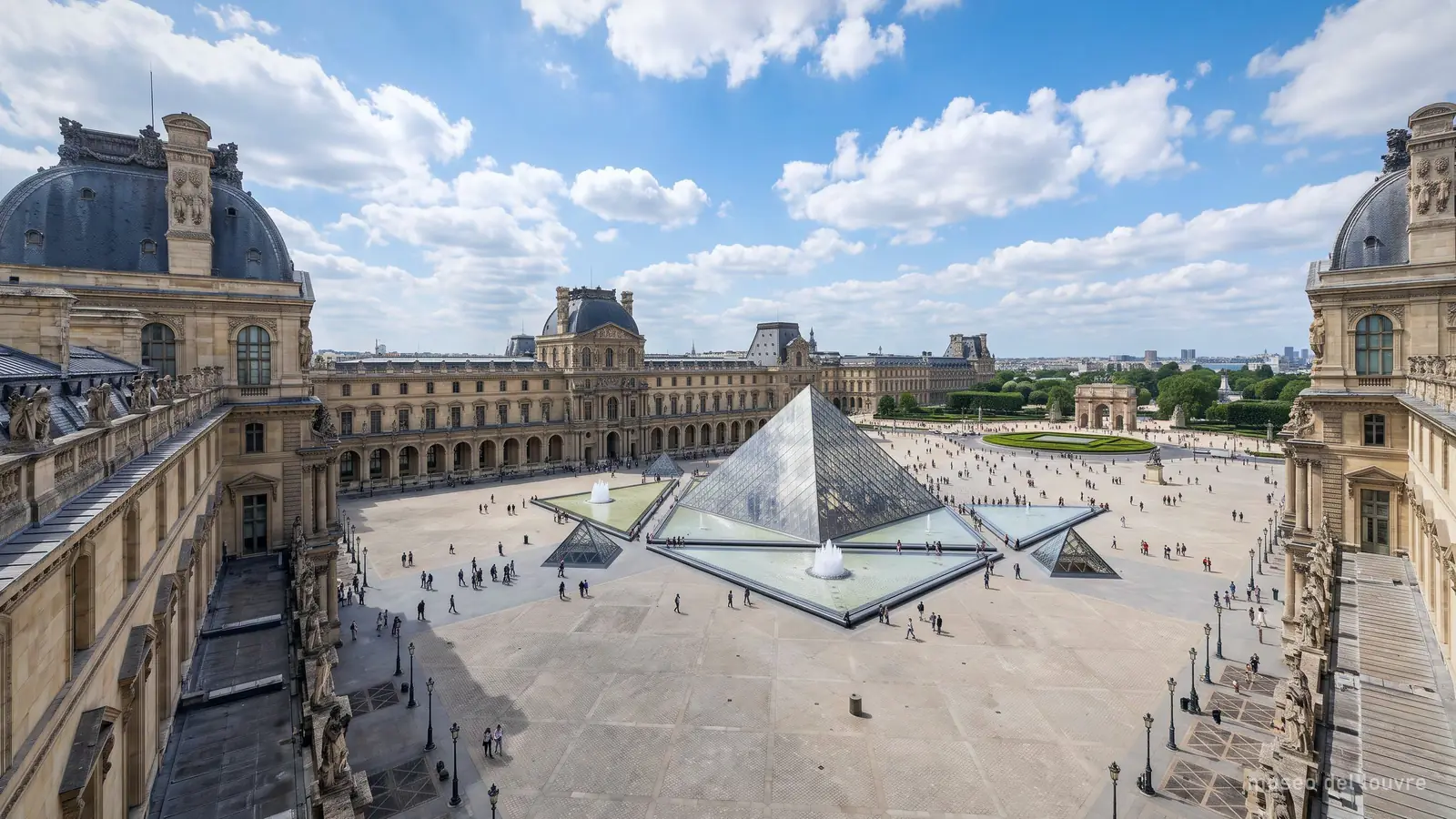
The Louvre Museum: A Guide to Planning Your Visit
Updated October 28, 2026
Quick answer
The Louvre Museum (Musée du Louvre) is France's national museum, in the former royal palace of the Louvre in the center of Paris. It displays about 35,000 works, from Antiquity to just before Impressionism, in three wings: Denon, Sully and Richelieu. It opens every day except Tuesday, a ticket costs 22 € for EEA residents (32 € for everyone else) and it is worth booking a time slot online.
| Fact | Value |
|---|---|
| Founded as a museum | August 10, 1793 |
| Total area | 210,000 m² |
| Gallery area | 60,500 m² |
| Works on display | About 35,000 |
| Visitors in 2025 | About 9 million |
| Daily cap | 30,000 admissions |
| General admission | 22 € (EEA) / 32 € (everyone else) |
| Closing day | Tuesday |
| Pyramid | I. M. Pei, opened in 1989 |
What it is and where it is
The Louvre occupies the former palace of the kings of France, in the 1st arrondissement of Paris, beside the Seine and the Tuileries Garden. It was founded as a museum on August 10, 1793, in the middle of the Revolution. The building covers 210,000 m², of which 60,500 m² are exhibition galleries. In 2025 it had about 9 million visitors, against 8.7 million in 2024, with a cap of 30,000 admissions a day set after 2018. The collections are split into eight departments: Egyptian antiquities, Near Eastern antiquities, Greek, Etruscan and Roman antiquities, Islamic art, sculpture, decorative arts, painting and prints and drawings.
The three wings: Denon, Sully and Richelieu
The museum has three main wings. Knowing which one holds what you are after saves you long walks:
- Denon (south) — The most visited: the Mona Lisa is here, in room 711 on the first floor, opposite The Wedding Feast at Cana. Also foreign sculpture.
- Sully (center) — The central wing, between Denon and Richelieu. During the 2026 works, the accessible route from Sully to the Mona Lisa goes down to level −1 and passes through the Pyramid.
- Richelieu (north) — French sculpture and, on the first floor, decorative arts.
Tickets and booking
General admission costs 22 € for EEA nationals or residents and 32 € for everyone else; under-18s and EEA residents under 26 get in free. It covers the permanent collections, temporary exhibitions and the Musée Eugène Delacroix within 48 hours. Booking a time slot online is the only way to guarantee entry, and from October 17 to November 1, 2026 it is mandatory for everyone. If you would rather go with a guide, tours with entry included start at $66 per person.
Hours and the best time to go
Open Monday, Thursday, Saturday and Sunday from 9:00 am to 6:00 pm and Wednesday and Friday from 9:00 am to 9:00 pm; closed on Tuesdays. Last admission is one hour before closing. The Paris Île-de-France tourist board advises going early, between 9:00 and 10:00 am, or on late-opening evenings, and avoiding weekends, public holidays and school vacations.
Which entrance to use
There are four entrances and not all of them work for everyone. With a booked ticket, the Pyramid has a priority line and is the main entrance:
- Pyramid — For everyone: a priority line for visitors with a ticket or a Paris Museum Pass, a separate line for those without, and a no-wait line for people with disabilities.
- Carrousel — Through the shopping gallery, at 99 rue de Rivoli; open to ticket holders.
- Porte des Lions — From quai François-Mitterrand, ticket holders only; open until 6:00 pm, last admission 5:00 pm, closed on Tuesdays.
- Passage Richelieu — Reserved for groups, tours organized by the museum and holders of certain passes.
What to see
With about 35,000 works on display, nobody sees everything in a day. The three works almost everyone looks for are Leonardo da Vinci's Mona Lisa, in the Salle des États (Denon wing), the Venus de Milo and the Winged Victory of Samothrace. Opposite the Mona Lisa hangs Veronese's The Wedding Feast at Cana, the largest painting in the museum, at almost 70 m². Among the most sought-after are also The Coronation of Napoleon, Liberty Leading the People and The Raft of the Medusa. The guided tours we sell cover these works in 2 to 2.5 hours.
Rules: bags, photos, cloakroom
You cannot bring in items larger than 55 × 35 × 20 cm; under the Pyramid and at the Porte des Lions there is a free cloakroom, which must be emptied the same day. You can take photos and videos for personal use in the permanent collections, but with no flash or selfie stick; some temporary exhibitions ban photography. You cannot eat or drink in the galleries, and animals are not allowed except assistance dogs. If you leave the museum, you can't get back in on the same ticket.
Services: food, audio guide, accessibility
The official audio guide costs 6 €, comes in 9 languages and covers about 150 masterpieces. There is free Wi-Fi (the connection renews every hour) and restrooms in the reception areas and in the galleries. At the help desk under the Pyramid, wheelchairs and strollers are lent free of charge in exchange for an ID document, and a cylindrical lift takes visitors with reduced mobility down under the Pyramid. The museum also has its own bars and restaurants.
Frequently asked questions
Where is the Louvre Museum?
In the 1st arrondissement of Paris, on the banks of the Seine, between the Tuileries Garden and rue de Rivoli. The nearest metro stations are Palais-Royal / Musée du Louvre (lines 1 and 7) and Pyramides (line 14).
What was the Louvre before it was a museum?
A royal palace, built on top of a medieval fortress. It became a museum in 1793, during the French Revolution.
How do you pronounce Louvre?
In French it sounds roughly like "loovr", a single syllable with the final r barely sounded.
What happens if I'm late for my Louvre time slot?
The ticket is only valid for the date and slot you chose and cannot be changed. The regional tourist board says a timed ticket guarantees entry within a 30-minute window, so arrive on time.
How much time do you need to see the Louvre?
For the best-known works, the guided tours we sell take 2 to 2.5 hours. Seeing the whole museum in a day is not possible: there are about 35,000 works in 60,500 m² of galleries.
Sources