
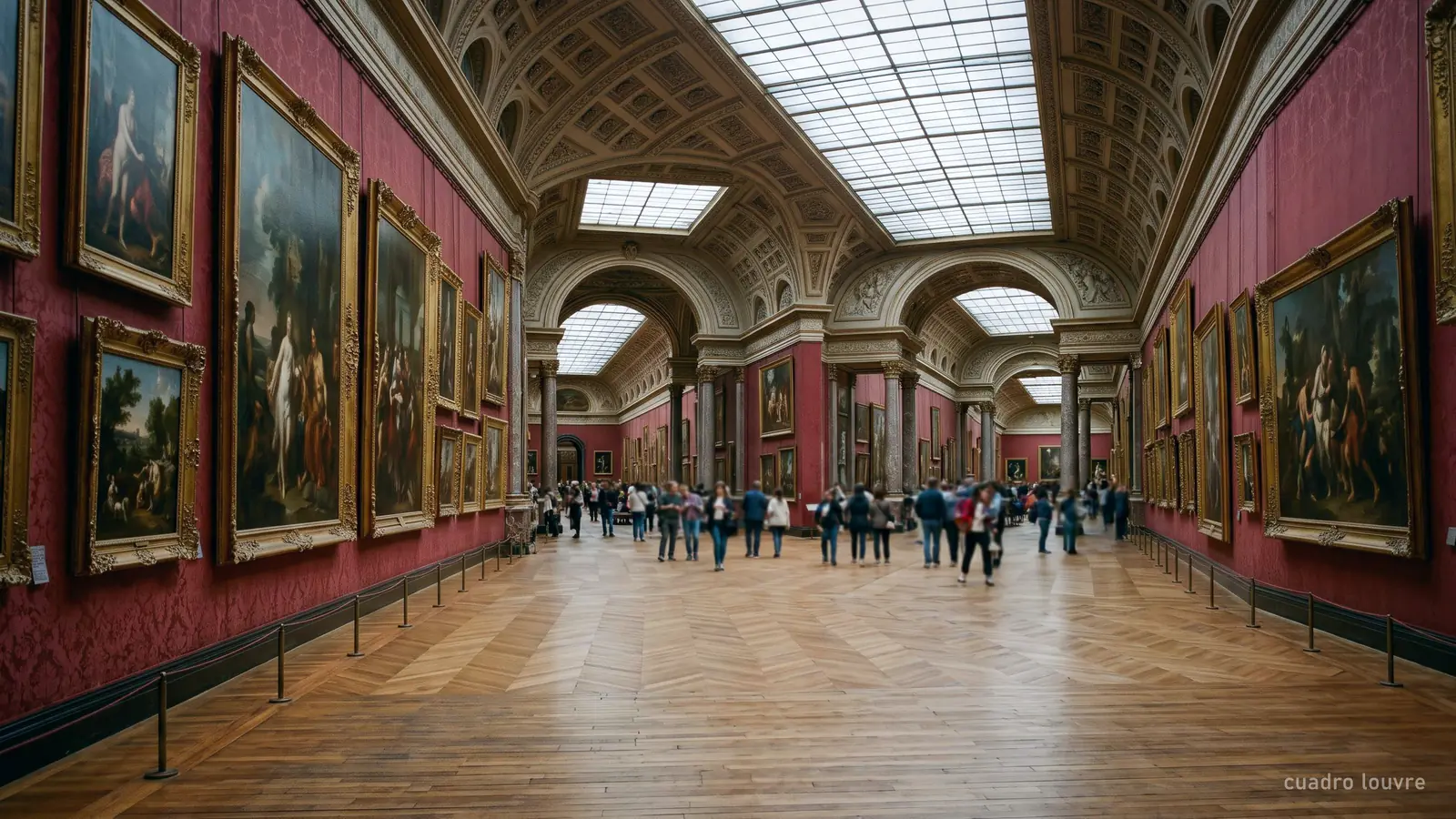
Louvre Paintings: The Most Famous and Where Each One Hangs
Updated October 28, 2026
The most famous of the Louvre paintings is Leonardo da Vinci's Mona Lisa, and the largest is Veronese's The Wedding Feast at Cana, which hangs right opposite it, in the same room 711 of the Denon wing. Almost all the paintings people come looking for are in that wing and on that level 1: Italian painting in the Grande Galerie, large-format French painting in room 700. This list ranks eleven famous paintings in the Louvre by fame and school, with the date, technique and size given by Spanish-language Wikipedia and, where the museum publishes it, the room.
- #1
Mona Lisa (La Gioconda), Leonardo da Vinci
Italian school. Room 711, the Salle des États, Denon wing, level 1.
Oil on poplar panel, 79 × 53 cm, begun around 1503 and probably retouched until 1519. It portrays Lisa Gherardini. It came to the Louvre in 1797, after the Revolution, and has been in the Salle des États since 1966, inside a case that controls temperature and humidity. Its fame soared after the theft of August 21, 1911: an Italian handyman walked off with it and it did not turn up again for more than two years.
- #2
The Wedding Feast at Cana, Paolo Veronese
Venetian school. Room 711, opposite the Mona Lisa: the largest painting in the museum.
Oil on canvas, 6.77 × 9.94 m, almost 70 m², painted in 1562–1563 for the refectory of the monastery of San Giorgio Maggiore in Venice. Veronese set the biblical miracle at a Venetian banquet of his own day. Napoleon's troops took it in 1797; it had to be rolled up for the journey and has been in the Louvre since 1798.
- #3
Liberty Leading the People, Eugène Delacroix
French painting. Room 700 (Salle Mollien), Denon wing, level 1.
Oil on canvas, 2.60 × 3.25 m, painted in 1830. It shows the three days of July 1830 against Charles X, not the Revolution of 1789. "It is a modern subject, a barricade," the painter said. The State bought it in 1831, but it was not shown at the Louvre until 1863. Today it is Delacroix's best-known work and a familiar image of the fight for freedom.
- #4
The Raft of the Medusa, Théodore Géricault
French painting. Room 700, the same room as Liberty Leading the People.
Oil on canvas, 4.91 × 7.16 m, painted in 1818–1819 and shown at the Salon of 1819. It tells of the wreck of the frigate Méduse in July 1816: according to the museum, of 150 castaways adrift for thirteen days only 15 arrived alive. In the eight months it took, Géricault met survivors and visited morgues and hospitals to observe corpses. It entered the Louvre in 1824.
- #5
The Coronation of Napoleon, Jacques-Louis David
French painting. The ceremony of December 2, 1804 in Notre-Dame.
Oil on canvas more than 6 m high and almost 10 m wide. David began it on December 21, 1804 and gave it the final touch in November 1807; it was exhibited in 1808. It is also known as The Consecration of the Emperor Napoleon. The painter later made a replica by his own hand, which is in the Palace of Versailles; the original is the one in the Louvre.
- #6
The Lacemaker, Johannes Vermeer
Dutch painting. A tiny picture: 23.9 × 20.5 cm.
Oil on canvas mounted on wood, painted around 1669–1670. A young woman bent over her lacework, in a minute format next to the giant canvases of the Denon wing. It was auctioned in Paris in 1870; the collector Eugène Féral sold it to the Louvre about two months later, and it was the first Vermeer to enter a French public collection.
- #7
The Virgin of the Rocks, Leonardo da Vinci
Italian school. The first of the two versions; the other is in London.
Oil, 199 × 122 cm, commissioned in 1483 and dated 1483–1486; it was painted on panel and transferred to canvas in 1806. The second version, from 1495–1508, is in the National Gallery in London. It is one of the five Leonardo paintings the Louvre holds; the museum also keeps twenty-two of his drawings.
- #8
La Belle Ferronnière and Saint Anne, Leonardo da Vinci
Italian school. Grande Galerie, room 710, Denon wing, level 1, on the way to the Mona Lisa.
Two more Leonardos, hanging in the Grande Galerie. The Portrait of a Woman, known as La Belle Ferronnière owes its nickname to a mistake by Ingres when titling an engraving; the sitter may be Lucrezia Crivelli, mistress of Ludovico Sforza, Duke of Milan. The Virgin and Child with Saint Anne, the Child playing with a lamb, brings together three generations in front of a landscape wrapped in Leonardo's sfumato.
- #9
The Oath of the Horatii, Jacques-Louis David
French painting. A commission from King Louis XVI, painted in 1784.
Oil on canvas, 3.30 × 4.25 m, painted in 1784 on a royal commission and first shown in the painter's studio in Rome in 1785. It shows the three Horatii brothers swearing an oath before their father, twenty years before David painted Napoleon's coronation.
- #10
La Grande Odalisque, Jean-Auguste-Dominique Ingres
French painting. An 1814 nude commissioned by Napoleon's sister.
Oil on canvas, 91 × 162 cm, painted in 1814 for Caroline Bonaparte, Queen of Naples, as a pendant to another nude, The Sleeper of Naples, now lost.
- #11
Botticelli frescoes in room 706
Florentine school. Room 706 (Salle Percier et Fontaine), Denon wing, level 1.
Venus and the Three Graces Presenting Gifts to a Young Woman and its pair, a young man presented to the Liberal Arts, are frescoes found in 1873 under a coat of whitewash in a villa near Florence; they came to the Louvre in 1882. They are beside the Daru staircase, between the Winged Victory of Samothrace and the Salon Carré, so you see them on your way through.
Frequently asked questions
What is the most famous painting in the Louvre?
Leonardo da Vinci's Mona Lisa, in room 711 (Salle des États) of the Denon wing, level 1. Behind it, in the same wing and level, are Liberty Leading the People and The Raft of the Medusa (room 700) and The Wedding Feast at Cana (room 711).
What is the largest painting in the Louvre?
Paolo Veronese's The Wedding Feast at Cana: 6.77 × 9.94 m, almost 70 m² of canvas. It hangs in the Salle des États, opposite the Mona Lisa, so you see it while you wait in line.
What important paintings are in the Louvre?
From the Italian school, Leonardo's Mona Lisa, The Virgin of the Rocks, La Belle Ferronnière and Saint Anne, and Veronese's The Wedding Feast at Cana; from the French, Liberty Leading the People, The Raft of the Medusa, The Coronation of Napoleon, The Oath of the Horatii and La Grande Odalisque; from the Dutch, Vermeer's The Lacemaker.
How many Leonardo da Vinci paintings does the Louvre have?
According to the museum itself, five paintings and twenty-two drawings. The most visited paintings are the Mona Lisa (room 711) and, in the Grande Galerie (room 710), La Belle Ferronnière and Saint Anne.
Where is Vermeer's The Lacemaker?
In the Louvre since 1870, when the collector Eugène Féral sold it to the museum. It was the first Vermeer in a French public collection. It measures only 23.9 × 20.5 cm, so it is worth finding it with the museum map.
Sources