
informational 5 min read
The Wedding at Cana: the Largest Painting in the Louvre
Updated October 28, 2026
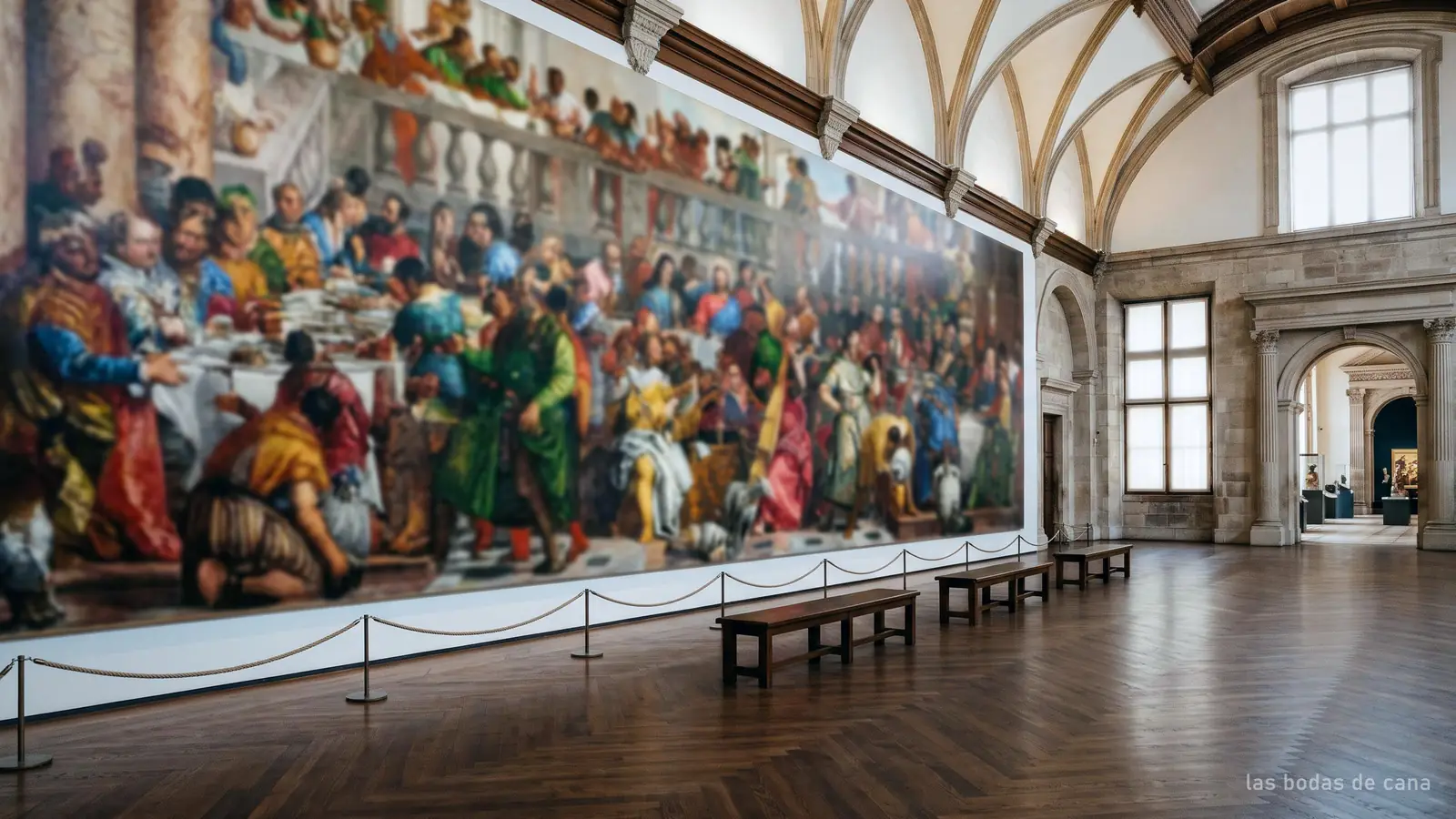
The largest painting in the Louvre is The Wedding at Cana by Paolo Veronese: an oil on canvas 6.77 m high by 9.94 m wide, painted in Venice between 1562 and 1563. The museum itself presents it as the largest painting in its collections, at more than 70 m² according to its notice, and hangs it in the Salle des États, directly opposite the Mona Lisa.
What is the largest painting in the Louvre?
It is Veronese’s The Wedding at Cana. The Louvre’s notice describes it as “the largest painting in the museum”, more than 6 meters high and almost 10 long. To get a sense of the scale, compare it with other huge canvases in the museum:
| Painting | Artist | Dimensions (height × width) |
|---|---|---|
| The Wedding at Cana | Veronese | 677 × 994 cm |
| The Coronation of Napoleon | Jacques-Louis David | 621 × 979 cm |
| The Raft of the Medusa | Théodore Géricault | 491 × 716 cm |
| Liberty Leading the People | Eugène Delacroix | 260 × 325 cm |
The Coronation of Napoleon comes close in width, but The Wedding at Cana is more than half a meter taller.
How big is The Wedding at Cana?
It measures 6.77 m high by 9.94 m wide, according to the data sheet in Spanish Wikipedia; the text of the same article gives slightly different figures (6.69 × 9.90 m), and the Louvre rounds it to “more than 6 meters high and almost 10 long”. The figures vary by a few centimeters depending on the source; none goes below 6.6 m high or 9.9 m wide.
The size was no whim: the 1562 contract required the canvas to be “as wide and as high as the wall” of the new refectory of the Benedictine monastery of San Giorgio Maggiore in Venice, for which it was painted.
What does The Wedding at Cana depict?
It depicts Jesus’s first miracle according to the Gospel of John (chapter 2): at a wedding in Cana of Galilee the wine runs out and Jesus turns the water in some jars into wine. Veronese moved the scene to a Venetian banquet of his own day, with classical architecture, musicians, servants and guests in lavish 16th-century clothes.
Jesus sits at the center of the table, with the Virgin Mary on his right and some apostles beside them. The newlyweds are not in the center but seated at the far left end. In all, the Louvre counts about 130 figures. A group of musicians plays in the middle of the courtyard; according to Spanish Wikipedia, Veronese painted himself among them with a viola da gamba, and tradition identifies Titian, Tintoretto and Jacopo Bassano beside him.
How did The Wedding at Cana end up in Paris?
It arrived as spoils of war. These are the key dates:
- June 6, 1562. The monks of San Giorgio Maggiore commission the painting. Veronese was to be paid 324 ducats, plus his board and a barrel of wine.
- September 1563. He delivers it after about fifteen months of work, probably with help from his brother Benedetto Caliari.
- 1798. Napoleon’s troops take it from the refectory, where it had hung for 235 years, and it reaches the Louvre.
- 1815. After the fall of the Empire, Antonio Canova negotiates the return of the Italian works. The painting stays in France: its fragility for such a long journey was cited, and Charles Le Brun’s The Feast in the House of Simon was handed over in exchange.
During the Second World War it was protected in the south of France, and it was restored between 1990 and 1992. There have been campaigns to return it to Venice, but it remains in the Louvre.
Where is The Wedding at Cana in the Louvre?
It is in room 711, the Salle des États, in the Denon wing, level 1, on the wall facing the Mona Lisa. It is the same room, so you do not need to look for it: when you are in line to see the Mona Lisa, turn around, and the largest painting in the museum is behind you.
If you are heading straight to this room, read where is the Mona Lisa first to get your bearings, and if you want to see it with commentary, the Louvre masterpieces guided tour includes the Mona Lisa, in this same room; it costs $66 and is rated 4.6 from 8,027 reviews of this tour on GetYourGuide. General admission costs 22 € for residents of the European Economic Area and 32 € for everyone else.
Check prices & dates
Book your tickets in advance: popular time slots sell out.
Book tickets
From$66per person
Check availability- Free cancellation up to 24 h before on 9 of 10 options
- Louvre entry included in all of them
- Prices in US dollars
Price checked Oct 27, 2026
Sources